


Is GitOps a technology choice, or is it a set of principles that can be implemented with any tool? The answer depends on who you ask, and that ambiguity has created real confusion in the networking world.
The origin: GitOps as developer-centric workflow
The term GitOps was coined in a 2017 blog post by Weaveworks CEO Alexis Richardson, where it was used to describe a system of managing “your entire system declaratively with Git and apply[ing] changes through Pull Requests.” The focus was on managing cloud-native applications, and Git was central to the definition.
Since then, various practitioners and organizations have expanded on Richardson’s original concept. While there’s some variation in how GitOps is defined, most definitions share at least four common components.
GitOps:
- Defines desired state in declarative code
- Stores that code in a shared Git repository
- Has version control on the code repository, and a defined change management process (typically a CI/CD pipeline) for versioning
- Has a way to automatically reconcile what’s deployed with what lives in the shared repo
But even this seemingly straightforward framework has been further refined and reinterpreted.
GitOps without Git
A CNCF sandbox project called OpenGitOps proposes a standardized, vendor-neutral approach that reframes GitOps slightly. The OpenGitOps principles state:
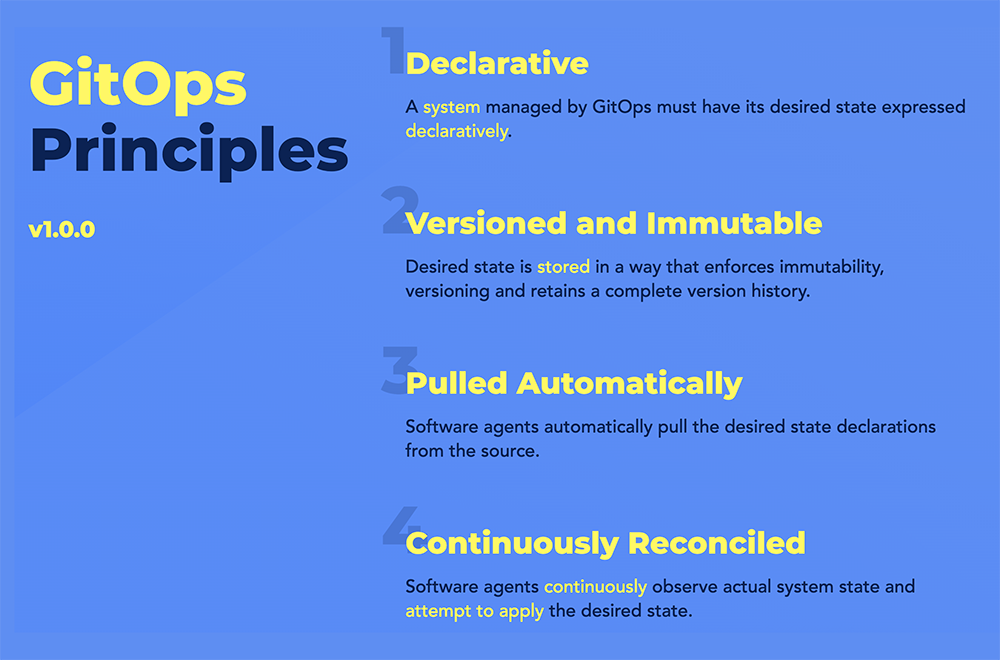
These principles are very close to our original definition, but with a few refinements: immutability is added to the requirement for versioning, and it’s specified that the change management process must facilitate automatic pulls.
What’s more glaring is what’s not in the CNCF definition: any mention of Git itself. According to OpenGitOps, any technology that supports these four principles qualifies as GitOps.
But this shift from “Git-based workflow” to “principles that could use any version control system” has not gained widespread awareness.
Network engineers define GitOps
For many network engineers, GitOps still means using Git:
“GitOps, to me, is closer to the technology. It’s almost like signaling [you’ve] already picked the technology as opposed to agreed upon the concept.” – Eric Chou, network automation engineer
“99% of the people, when you say GitOps, either think GitHub or GitLab.” – Scott Robohn, co-founder, Network Automation Forum
“GitOps and OpenGitOps, I guess I’m not 100% sure what that is, either of those. But it might mean the way you use Git in your operations.” – Barrie Cook Jones, networking and automation consultant
A few focus on the core concept of version control in their definition:
“For me, it’s a way to operationalize my revision control and take actions on changes in this kind of revision control world that Git offers us.” – Claudia de Luna, networking and automation consultant
“At the end of the day, it’s about source code control. And this is not new. We’ve been using this for decades.” – Scott Robohn, co-founder, Network Automation Forum
Only one engineer I spoke to had even heard of the CNCF’s OpenGitOps idea, and could lay out its four principles. In contrast to many others, GitOps for him was about the framework, not the technology:
“GitOps or OpenGitOps principles for me are principles, how we approach a problem, how we solve a problem…. And fun fact: You don’t have to use Git.” – Urs Baumann, network automation engineer
Networking had GitOps before GitOps
Here’s what makes this especially interesting for networking: network engineers were using Git-based workflows for infrastructure automation before the term GitOps existed.
At a 2015 RIPE event—two years before the term GitOps was coined—network engineer Leslie Carr gave what might be the first talk about using Git for version control in network automation. The title of her talk was “What Is NetDevOps?”, and in her framework, Git-based version control was a component of NetDevOps.

Despite this early discussion, the term GitOps didn’t gain traction in networking circles for years. In 2018, after GitOps had been coined, Ivan Pepelnjak wrote GitOps in Networking, noting that while the concept wasn’t new, many network engineers still weren’t familiar with it.
Throughout the late 2010s, some network engineers were certainly experimenting with Git-based workflows, but it wasn’t a commonly discussed concept.
It wasn’t until 2023 that the term GitOps began appearing more frequently in a networking automation context, usually incorporated into broader discussions of NetDevOps, Infrastructure as Code, and version control.
As recently as April 2025, network engineer Jeffrey Lyons published a guide on GitOps for Network Engineers, with an introduction that talked about how his perspective on networking “shifted dramatically” after a colleague introduced him to GitOps. “I’m wondering why I didn’t adopt this approach much earlier in my career,” he writes.
Lyons’ experience illustrates that even today, GitOps remains something of a well-kept secret in the networking community that relatively few stumble across or embrace.
GitOps in networking TL;DR
GitOps is a set of operational principles that, in the context of network management, focuses on infrastructure being stored as versionable, declarative code.
Most automation practitioners assume GitOps uses Git but there’s a movement from the CNCF to make it tool-neutral.
In practice, infrastructure as versionable, declarative code is a component of both Infrastructure as Code and NetDevOps so it’s unlikely GitOps is the term that network automation engineers will rally around.

