

Working in network and infrastructure management can sometimes feel like you spend your days in an Ella Fitzgerald song:
You like potato and I like potahto
You like tomato and I like tomahto
Potato, potahto, tomato, tomahto
Let's call the whole thing off
Except we don't have just two ways to say what we do—we have dozens.
DevOps, NetDevOps, Zero DevOps, GitOps, Infrastructure as Code, Network as Code, network automation, programmatic networks, network orchestration, software-defined networking, intent-based networking, AIOps, hyperautomation, NFV… the list scrolls on.
Some of these terms have become popular. Some have failed. Many overlap.
The ‘what do words mean’ problem
Network operations conversations can get messy fast. Not only is there a bewildering number of terms, we also don’t agree on how many of those terms are defined.
“What do words mean? That is a theme that's come up in certain of the conferences and certain of the talks,” says Ethan Banks, co-founder of Packet Pushers:
“Someone will say something that means something to them, and something subtly different or maybe significantly different, to someone in the audience. There is some confusion about what we're talking about.”
Now add in some overlap on key concepts. Infrastructure as Code, Network as Code, and GitOps, for example, share extremely similar definitions that emphasize declarative code, version control, and automated deployment. NetDevOps and network orchestration both focus on coordinating workflows to deliver services.
Are we describing different things, or just using different words for the same concepts? And would we even know if we don’t agree on the definitions in the first place?
Banks says the lack of clarity is definitely a problem:
“I don't even know what the right conversation is to have anymore because of this bad fracturing that we've got in the industry.”
Automation engineer Urs Baumann thinks the splintering has to do with marketing:
“It sounds fancy. DevSecOps sounds probably more sexy than just DevOps. So we try to use more and more different words… [But] at some point, they are just losing the meaning."
So where do we go from here?
Scott Robohn, co-founder of the Network Automation Forum, believes labels matter but we’ll never get universal agreement because that’s just human nature:
“People are going to do what people are going to do. As soon as you try to force or control, you'll find people who want to rebel against it just for the sake of rebelling against it. But if you can get 80% consensus on something, be it terminology or other, I'd say that's pretty good.”
And network automation engineer Eric Chou argues that moving forward is more important than perfecting terminology:
"If we spend too much time on coming up with common terms, then we run the risk of analysis paralysis. So I don't want to get stuck on the terms. As long as we could agree on the general high level of what it is, then we can move forward. And moving forward is the most important thing for me, just having that momentum."
So in the spirit of helping us all move forward, we’ve put together this multi-part guide on seven key terms.
- DevOps
- NetDevOps
- GitOps
- Infrastructure as Code (IaC)
- Network as Code (NaC)
- network automation
- network orchestration
Below, you’ll find a quick definition of each term, and a timeline of when they appeared in the industry lexicon.
From there, you can jump into detailed explorations that look at where the names come from, debates around definition, and why some terms caught on better than others.
Quick reference: 7 ops definitions in a nutshell
DevOps
DevOps is both a mindset and a set of technical practices. The mindset emphasizes cross-team collaboration, open communication, continuous improvement, and integrated workflows. Technical practices include the use of CI/CD pipelines, version control, and automated testing.
NetDevOps
Just as it sounds, NetDevOps means applying DevOps principles to networking. The resulting definition: a collaborative, cross-team mindset paired with a CI/CD workflow that supports versioning and automated testing of network changes.
GitOps
In the formal definition, GitOps is a set of operational principles that treat infrastructure as versioned, declarative code stored in a central repository. But most engineers define it simply as using Git in a workflow.
Infrastructure as Code (IaC)
Infrastructure as Code uses declarative, version-controlled code files to define and provision infrastructure. It typically includes templated configurations, centralized source control, API-driven automation, and CI/CD workflows. While the principles can apply to any infrastructure, IaC is predominantly associated with cloud management.
Network as Code (NaC)
Network as Code describes applying Infrastructure as Code principles—version control, declarative configuration, automated testing, CI/CD pipelines—to physical network infrastructure.
Network automation
Network automation uses software to perform network tasks that would otherwise be done manually. It’s a small definition that covers a huge range of activity, from basic Python scripts to AI-driven, self-healing networks.
Network orchestration
Network orchestration is the coordination of multiple automated tasks into a complete, end-to-end service workflow. Automation and orchestration work together, with orchestration providing the coordination layer that transforms isolated automated tasks into complete services.
The timeline of ops terminology
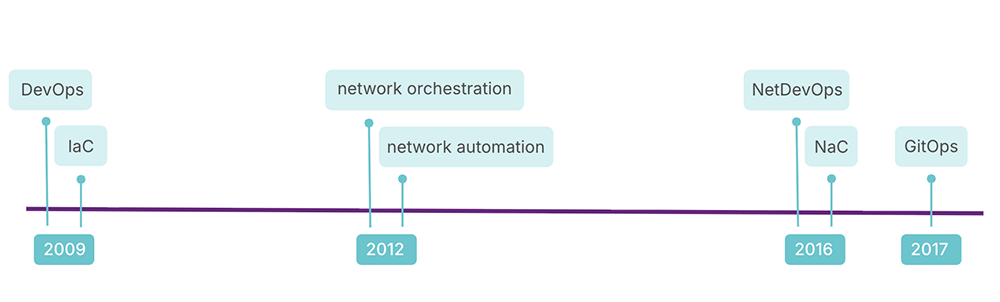
2009: DevOps starts it all
“DevOps” is born at the first DevOpsDays conference in Belgium, establishing the mindset and technical practices that would influence everything to follow. Soon after, Infrastructure as Code joins the lexicon as practitioners explore how to apply DevOps principles to infrastructure management.
2012-2013: Network orchestration emerges
Network engineers begin to experiment with programmatic approaches to network configuration, adding “network automation” to our vocabulary. The European Telecommunications Standards Institute (ETSI) formalizes "network orchestration" in their NFV framework.
2014-2016: Network automation builds momentum
Kirk Byers develops Netmiko, David Barroso and collaborators create NAPALM, Ivan Pepelnjak hosts network automation discussions on his Software Gone Wild podcast, and automation consulting companies start up. The phrase spreads through blogs, conferences, and community discussions. By 2016, it's moving mainstream.
2016-2017: New names appear
NetDevOps appears as a name for bringing DevOps to networking. Network as Code slips into the conversation, as a way to distinguish how IaC principles are applied to physical infrastructure. GitOps is coined.
2018-2025: Natural selection does its work
Between 2016-2018, “network automation” becomes the dominant term. NetDevOps struggles for universal adoption. GitOps finds a home in cloud-native/Kubernetes environments but remains less relevant in traditional networking. Network as Code fades. By 2023, the Network Automation Forum launches, and their choice of name tells the story.
Explore the full guides
- What DevOps and NetDevOps Mean for Network Engineers?
- What Is GitOps for Network Engineers?
- What Network as Code and Infrastructure as Code Mean for Network Engineers
- What Network Automation and Orchestration Mean for Network Engineers
Coming soon: What is AIops for Network Engineers?