

aka A Field Guide to Unhealthy Intent Data Relationships
Your network source of truth (NSoT) is supposed to bring order, consistency, and clarity to your automation. But if your platform explodes when you change a schema, requires a week of testing for a patch release, or leaves you stuck on a 2021 version, you may be in a toxic relationship.
In other words, your NSoT has boundary issues.
As in human relationships, weak boundaries in intent data systems can lead to emotional burnout, broken trust, failed initiatives, and automation stagnation.
5 signs your NSoT has boundary issues

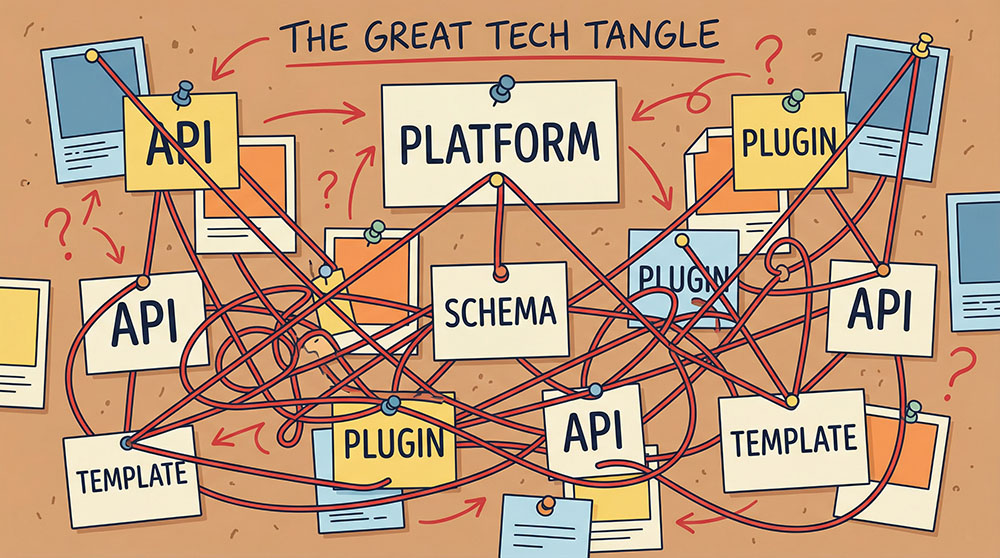
1. Everything is connected. And not in a good way.
A schema tweak breaks a plugin. That plugin powers a config template. That template drives an orchestration workflow. Suddenly, changing a single field can reroute your entire deployment pipeline.
📋️ Diagnosis: Enmeshment. You have no separation of concerns.
2. Your NSoT needs constant reassurance.
A patch update requires a month of testing. A minor version bump becomes a cross-team event. You’re scheduling therapy sessions for your CI pipeline.
📋️ Diagnosis: Insecure attachment to the schema.

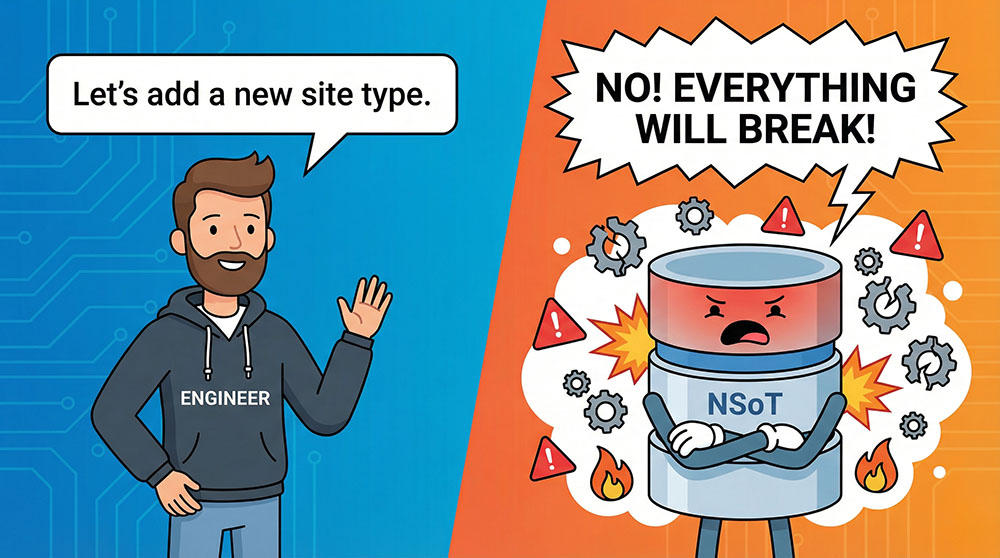
3. Any change turns into a fight.
Need to support a new site type or vendor? Great. But to do it, you have to reverse-engineer your own tooling stack and hope nothing breaks downstream.
📋️ Diagnosis: Boundary collapse between schema and application logic.
4. You’re stuck in the past.
You haven’t upgraded your NSoT in years because you’re afraid everything will break. And your fears are correct. Your plugins depend on undocumented schema internals written by someone who left 18 months ago.
📋️ Diagnosis: Version trauma. You’re emotionally (and technically) frozen.

5. You and others around you are losing trust in the data.
The schema is so customized (and so fragile) that engineers start bypassing it. Intent data starts moving to other systems.
📋️ Diagnosis: Communication breakdown. Your source of truth is no longer true.

What healthy boundaries look like
Boundaries are how systems grow without becoming brittle. A healthy, maintainable NSoT platform should include:
👍🏼 Decoupled architecture: Schema, application logic, and rendered outputs are separated with clear, versioned contracts.
👍🏼 Composable extensions: Plugins don’t rely on internal structures and can evolve independently.
👍🏼 Stable upgrade paths: New platform versions don’t require rewriting your automation.
👍🏼 Schema independence: Your data model isn’t hostage to the product version.
👍🏼 Trustworthy data: Engineers rely on the NSoT as the system of record, not as an afterthought.
A platform that respects boundaries gives you velocity without drama.
If your NSoT makes you feel like every change is a crisis, it’s not you—it’s the architecture. Choose platforms built for change, not control.
Your infrastructure deserves a healthy relationship.