

Before we can begin any discussion of NetDevOps, we first need to understand the parent concept from which it inherited so much: DevOps.
What is DevOps?
In 2009, a Belgian consultant named Patrick Debois championed a new workflow concept he called DevOps, an agile software development process that connected two traditionally siloed teams: the developers responsible for building software, and the ops or infrastructure team responsible for maintaining the systems that ran the software.
Today, DevOps is almost universally described as a culture or a mindset, as much as a technical framework.
The key components of a DevOps mindset include a focus on collaboration, communication, shared responsibility, and continuous improvement. It assumes a work process that’s integrated and agile, with multiple contributors performing tasks at the same time.
The DevOps technical approach is known to embrace a CI/CD (continuous integration/continuous deployment) pipeline in which changes are versioned, testing plays a critical role, and automation is used wherever possible.
The goal of DevOps has always been to provide software applications “faster, more often, more reliably, and aligned with business requirements.” As a testament to its effectiveness, nearly 80% of companies worldwide have adopted DevOps principles, according to data from devopsbay.
What is NetDevOps?
In its simplest definition, NetDevOps is a version of DevOps for networking (which is why you’ll sometimes also see it referred to as network devops).
But what does that mean exactly? Can we map the goals, mindset, and technical processes of software development directly to network management?
The answer is complicated. Some components of DevOps layer onto networking very well. Others not so much.
Do DevOps principles translate to networking?
To understand NetDevOps, we need to break down whether each component of DevOps can actually work in a networking context.
The goal is the easy part. Few would debate that networking should aim for what DevOps achieved in software: a fast, safe, iterative way to reliably deliver on business goals. Network teams want the same velocity and reliability that development teams have found.
The mindset of cross-team collaboration and integrated workflows is also an admirable ideal for networking. But it’s an ideal that many engineers struggle with.
“If we took anything away from DevOps, I wish it would have been we cannot be siloed,” says network and automation consultant Claudia de Luna. “Unfortunately, network engineers don't think that way. That's a management problem, that's an organizational problem, and usually that's where the wheels come off the wagon.”
Hank Preston of Cisco points out that companies embracing NetDevOps “see network changes as routine and expected,” a perspective that also runs against the ingrained habits of engineers used to slow rolling network changes to ensure nothing breaks.
In these ways, Jason Edelman of Network to Code is absolutely correct when he describes NetDevOps as “a fundamental shift in network operations.” The mindset change is real and difficult for many organizations.
The technical components of DevOps present a different type of challenge. CI/CD pipelines, automated testing, and version control work pretty easily when you’re dealing with software code.
But infrastructure data, especially from physical networks, is fundamentally different from software code. It’s highly structured and deeply interconnected. To move that data quickly and safely through a DevOps-like process, any tools in the workflow need to understand the relationships that exist, be able to validate dependencies, and to track their evolution over time.
This technical reality made Scott Robohn, co-founder of the Network Automation Forum, initially skeptical of the term:
“Two, three years ago I was very much, ‘No, there's so much dependency on forwarding hardware for networking that you'll never be able to call it NetDevOps with a straight face,’ to ‘Yeah, maybe 90% of it does apply DevOps to networking. And therefore there's a valid NetDevOps definition.’”
Despite these challenges, the industry as a whole seems have landed on a definition of NetDevOps that mirrors DevOps almost exactly:
NetDevOps is a collaborative, cross-team mindset paired with a CI/CD workflow that supports versioning and automated testing of all network changes.
Automation engineer Urs Baumann even asks:
“Why do we need to put Net before DevOps? DevOps itself is just the mindset that we don't have these silos… I believe we just put Net in front of it to make sure that we can distinguish it.”
A brief history of the NetDevOps term
If the definition worked conceptually, you might expect NetDevOps to have become the standard way to describe modern network operations, especially given the popularity and near-universal recognition of DevOps, its parent concept. But that’s not what happened.
A May 2016 blog post called What Is Net DevOps? is one of the earliest online uses of the term.
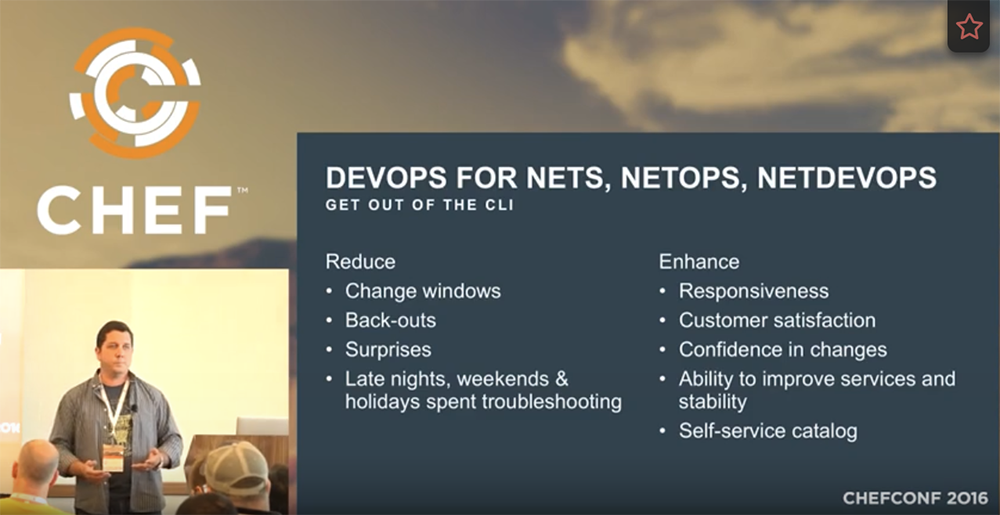
Later that year at ChefConf, Arista engineer Jere Julian presented a talk called “DevOps for Networks, NetDevOps, NetOps or Whatever”—a title that clearly conveys there was an appetite for adapting the DevOps framework but no agreement on a name for it.
By late 2017, Cisco’s Preston had become NetDevOps' most visible evangelist, publishing blog posts defining the term and advocating for its adoption. Today, Cisco has shifted to the term DevNet to encompass network automation and Preston no longer champions “NetDevOps.”
Between 2016 and 2020, the NetDevOps Survey collected data about how network engineers were implementing automation. Notably, given the title of the survey, its stated goal was to "understand how network operators and engineers are using automation to operate their network," reflecting the synonymous usage of NetDevOps and network automation that remains common today.
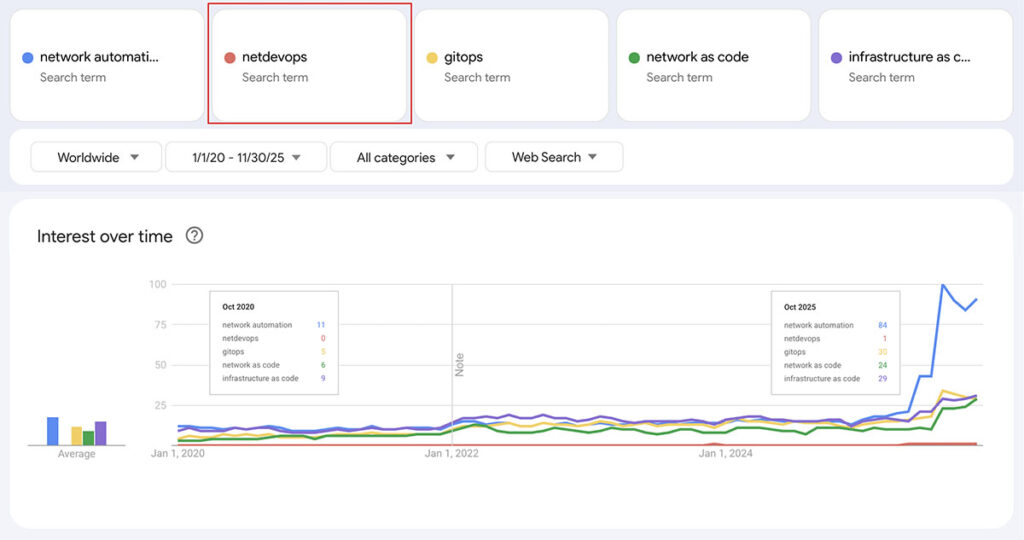
Despite industry and community use like these examples in the late 2010s, the term NetDevOps never really took off as the default or preferred term for modern network operations. As an example, Google Trends data shows that search interest has remained too low to even register for most of the last 6 years.
Why NetDevOps never caught on big
The term's failure to gain traction may well be its close association with DevOps. For many network engineers, borrowing from DevOps didn’t seem like an asset—it felt like a barrier.
In a blog post called What’s DevOps Got to Do With It?, de Luna writes:
“IF a network engineer figures out what "DevOps" is, it will look like some kind of strategy or a set of principles for software developers (typically coming from Cloud environments).
And they will say..."OK, that is not me"...and set the expectation that to adopt "netdevops" whatever that is, they have to become a software developer. Many network engineers went into network engineering to avoid software development!”
What NetDevOps means to network engineers
So what does NetDevOps mean to engineers? Even those who aren’t intimidated by the term don’t agree on the details. As Baumann quips, “You can ask 10 people, you will have 11 opinions.”
Some equate NetDevOps with network automation:
“NetDevOps is infrastructure as code. It is network automation. It is open communication.” - Datapath.io
Others reject that equivalence:
“... we are cheating ourselves in the networking industry if we simply make “NetDevOps” another word for automation.” - Hank Preston, Cisco
There's no agreement on whether NetDevOps is a subset of automation or the other way around:
“In our context, I think that DevOps is the big bubble. NetDevOps is a smaller bubble. And automation is yet another smaller bubble within NetDevOps.” - Eric Chou, network automation engineer
“NetDevOps is.. a subset of network automation. Network automation is a broader umbrella. - Christophe Fauveau, network automation architect
For some, NetDevOps implies network self-service:
“NetDevOps speaks to me more at a level of, we have a process by which we accomplish certain things on the network. There's probably a self-service model… I guess it doesn't have to mean self-service, but it probably means that, or that you're headed in that direction.” - Ethan Banks, Packet Pushers
“[NetDevOps means] moving towards a ‘push button, receive functionality’ way of managing your network.” - SevaraB, Reddit
And for others, NetDevOps remains focused on enabling faster software delivery rather than transforming network operations:
“NetDevOps is a way to build network automation into the application development process, so that an application can understand the infrastructure needs and be programmed to create networking resources on demand.” - R. Scott Raynovich, Futuriom
“The end goal continues to be the high velocity delivery of applications and services. However, to meet that goal, networking infrastructure changes must be deployed quicker so they aren’t the bottleneck in the delivery cycle.” - Ivo Pinto and Sidhartha Chauhan, Amazon
NetDevOps TL;DR
NetDevOps is meant to describe a collaborative, cross-team mindset paired with a CI/CD workflow that supports versioning and automated testing of network changes—basically DevOps principles applied to networking.
Despite conceptual clarity and evangelism efforts in the late 2010s, the term has never gained mainstream traction. Network engineers often find it intimidating or confusing, associating DevOps with software development rather than network operations. Those who do use the term don’t necessarily agree on what it encompasses.