

The most expensive technology decisions aren't the ones with high upfront costs. They're the ones that slowly consume your team's capacity to innovate.
When a UK-based financial services company we’re working with analyzed their automation infrastructure, they discovered 80% of their engineering effort was being spent maintaining their tools rather than building new automation capabilities.
When they’d chosen their tools, they’d optimized for the ones that provided the quickest time-to-value. It seemed like a smart selection criterion. But over time, those quick-start tools turned into a maintenance burden that has prevented them from keeping pace with business requirements.
Quick start vs long-term maintenance
Most engineers evaluating network source of truth (NSoT) platforms focus on immediate concerns: Does it model my infrastructure? Can I customize it? How quickly can I deploy it?
These questions matter but they miss a really critical one: What does maintenance look like in two years?
I’ve seen this pattern repeat countless times, both in client organizations and places I’ve worked as an engineer: an NSoT platform gets deployed, custom fields get added, plugins are introduced. Then more plugins to work around limitations in earlier plugins.
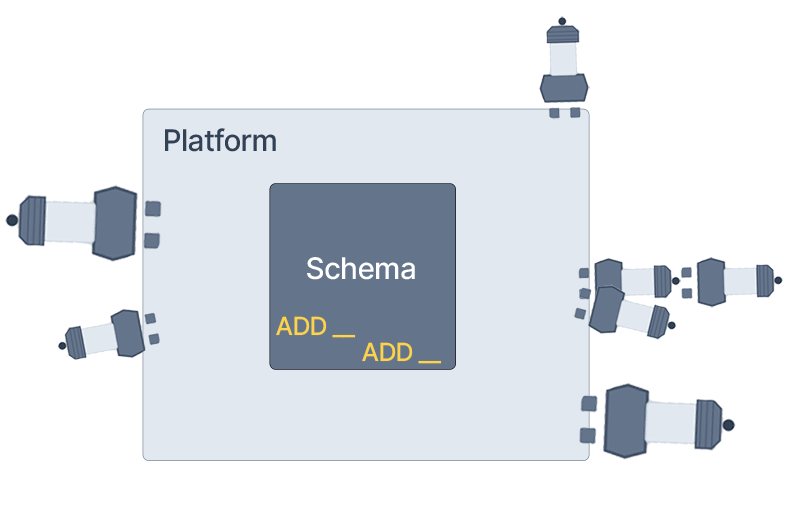
Each addition feels manageable in isolation but put together they create brittle dependencies that turn platform upgrades into high-risk events needing extensive testing cycles.
Two companies we're currently working with at OpsMill—one in aerospace, another in retail—both run NetBox instances so heavily customized through plugins that they're stuck on versions from three years ago.
Their engineering teams just don’t have the capacity for the testing required to validate that their plugins will still work after a platform upgrade. Meanwhile, security patches and feature improvements have accumulated in versions they can't safely deploy.
The compounding cost of coupled architecture
The root cause of this maintenance nightmare is architectural coupling.
When a platform tightly couples its schema to its feature set, every product evolution requires schema changes. Schema changes require API changes. API changes break integrations. Breaking integrations requires testing. Testing requires time. Time is the constraint.
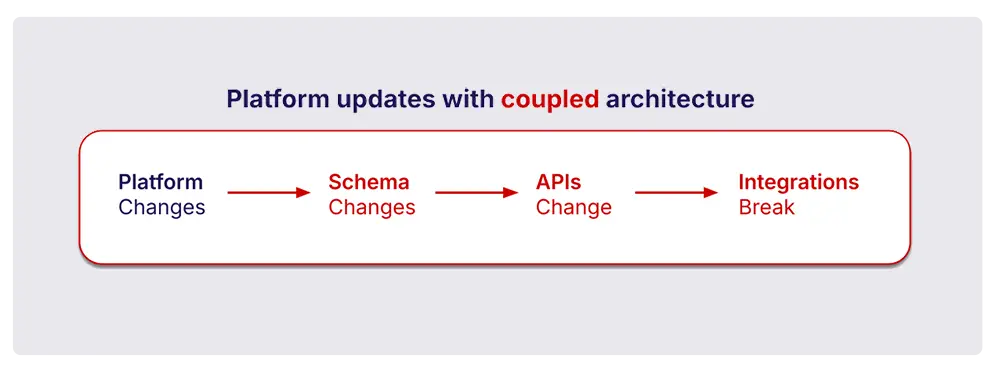
This architectural coupling creates a maintenance tax that grows faster than your infrastructure. Each new integration point adds test surface area. Each custom extension adds fragility. Each skipped upgrade increases the eventual migration burden.
But the maintenance tax is only half the problem. The real cost is what your team can't build while they're trapped in maintenance mode.
Every hour you spend testing plugin compatibility after an upgrade is an hour not spent automating a new service delivery workflow. Every week you delay a security patch is a week of elevated risk. Every quarter you’re stuck on an old version of the platform is a quarter where you’re falling behind on building capabilities that could differentiate your infrastructure delivery.
The platform you can deploy quickly with minimal upfront investment often creates the highest long-term cost, slowly eroding your team's capacity to respond to business needs.
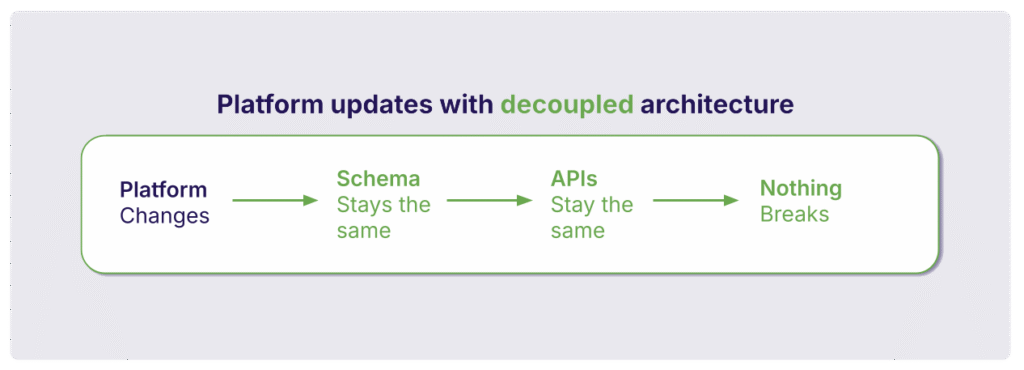
Contrast this with a decoupled architecture where the schema definition is separate from platform features.
When your data model exists independently of the product version, upgrading the platform doesn't invalidate your API contracts. Your integrations don't break. Your testing burden stays manageable and your engineering capacity remains available for building capabilities rather than maintaining foundations.
The warning signs your NSoT costs are too high
How do you know if your maintenance burden is already too high and holding you back? Look for these telltale signs:
Version drift: Your team is stuck on old versions of your NSoT platform because the risk to upgrade is higher than your capacity to test. The gap between your deployed version and the latest security patch grows each quarter.
Person dependency: Custom plugins are maintained by a single engineer who "just knows how it works." If they quit tomorrow, you're stuck. Your bolt-ons are undocumented, untested, and can’t be upgraded.
Testing ceremonies: Every minor version upgrade needs extensive integration testing that spans weeks. Bug fix releases have to be planned projects rather than running as routine maintenance.
Feature freeze: New infrastructure requirements pile up because your team lacks the capacity to extend the platform. The backlog of "we should model this" items grows while your engineer time is consumed with keeping existing customizations functional.
Integration fragility: Changes to one system cascade through multiple integration points. The fear of breaking something prevents changes, creating a form of organizational paralysis.
Data skepticism: Engineers are losing trust in the data accuracy because the schema is brittle or heavily customized through fragile plugins. They tend to bypass the platform and rely on manual checks or secondary sources, which further degrades the platform's usefulness and increases operational risk.
Questions that reveal hidden maintenance costs
When evaluating an NSoT platform, ask these questions:
✔️ Can you upgrade the platform without breaking integrations?
If the schema and API contracts are coupled to product versions, every upgrade becomes a risk event.
✔️ Can you customize without vendor dependency?
Plugin architectures create tight coupling to vendor release cycles. Schema-first approaches put you in control.
✔️ What happens when your primary maintainer quits?
If custom extensions are person-dependent, you've created a single point of failure in your automation infrastructure.
✔️ How do you handle security vulnerabilities?
If applying security patches requires extensive testing due to custom modifications, you've created a security risk that compounds over time.
What a sustainable NSoT looks like
An NSOT built on a sustainable, decoupled architecture shares these characteristics:
- Schema independence: The data model exists separately from platform features. Upgrading the tool doesn't change your API contracts.
- Clear boundaries: Data modeling, validation logic, and integration points are cleanly separated. Changes to one don't cascade through others.
- Progressive enhancement: New capabilities layer on top of existing foundations without requiring rewrites or migrations.
- Explicit contracts: APIs, data models, and integration patterns are versioned and documented as first-class artifacts, not emergent properties of implementation choices.
When these architectural principles are in place, the platform can evolve without creating upgrade trauma for your team. Your engineering capacity remains available for business priorities rather than getting consumed by technical debt service.
When evaluating source of truth platforms, look for a decoupled architecture designed for evolution, not just deployment. And prioritize maintenance burden as a first-order concern. Your future self will thank you.
Next steps
Infrahub is a data management platform built on a decoupled architecture that eliminates the maintenance trap described in this post. Ready to see how it works? Request a demo to explore how Infrahub's architecture scales with your infrastructure without scaling your maintenance burden.